
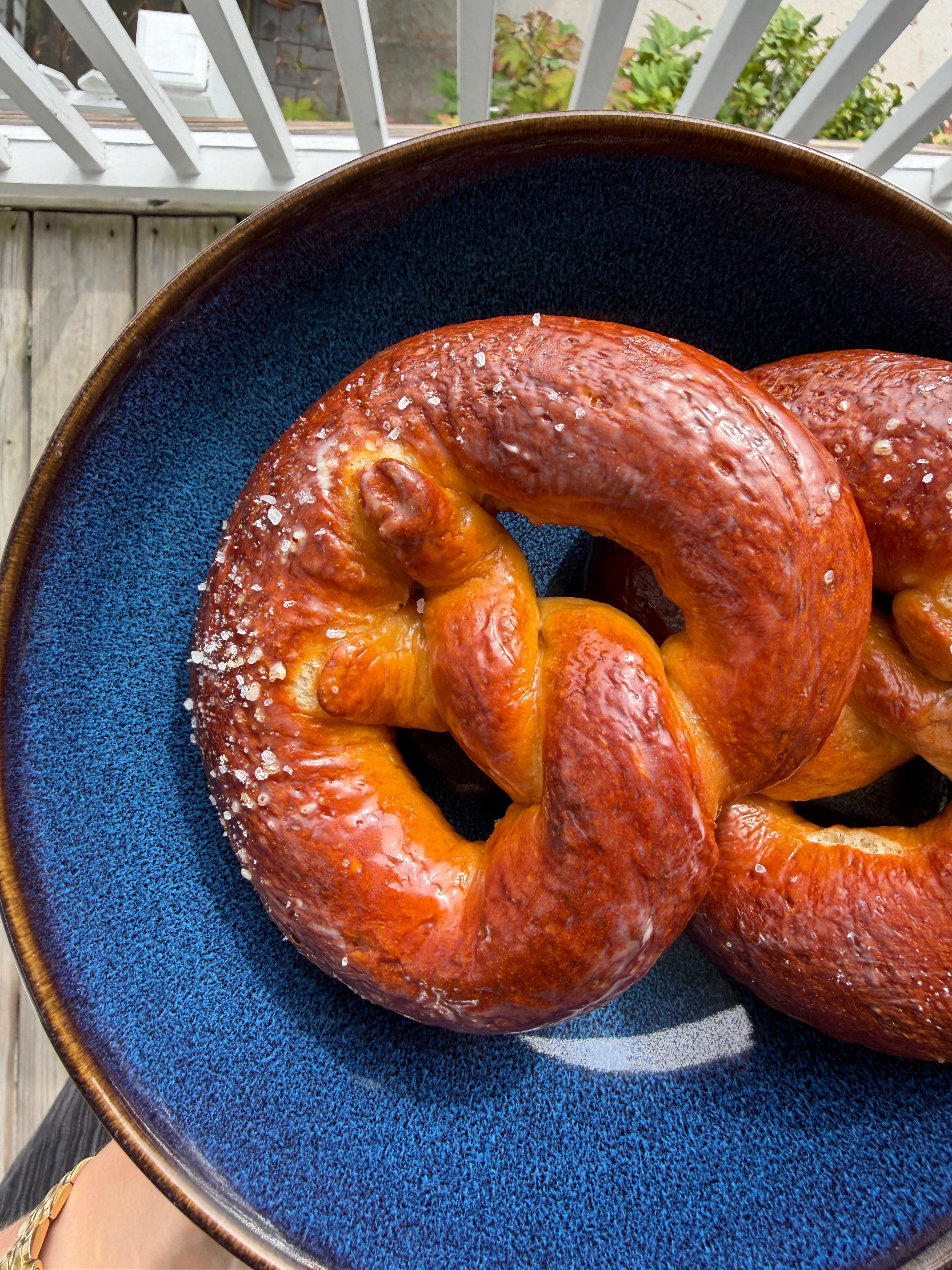
Soft Buttery Pretzels
These soft, buttery pretzels are chewy on the inside and crispy, deep-golden brown on the outside, with a rich butter-brush right as they come out of the oven. A great American twist on a German classic!
 Slotted spoon
- Pastry brush
 Bread
Soft Buttery Pretzels
Soft and buttery pretzels prepared in a baking soda bath for the classic golden brown pretzel crust, these are easy to make at home and always a hit.
Ingredients
Method
60g baking soda
Preheat your oven to 250 °F (120 °C) and line a baking tray with parchment paper. Spread the baking soda out on the paper and place in the oven, bake for 1 hour. This changes the chemistry of the baking soda, making your pretzels brown faster and deeper in the oven. If you want to know more about this process, see the note below.
143g water, 14g light brown sugar, 4g active dry yeast
In a medium bowl, add your water, sugar and yeast and give it a quick stir. Let this sit for about 5 minutes or until it's foamy, indicating that the yeast is alive.
250g bread flour, 5g fine salt
In a separate bowl, mix the bread flour and salt.
15g unsalted butter, melted
Stir the butter into your yeast mixture and add it to the dry ingredients. Stir with a wooden spoon or spatula until a shaggy dough forms, then tip out on a clean work surface.
Knead the dough for 10 minutes, then check if it passes the windowpane test. If it passes, roll the dough into a tight ball and let proof in a warm place for 60 minutes in a very lightly greased bowl covered by plastic wrap or a damp towel.
Preheat the oven to 450 °F (230 °C). Your dough should have doubled in size by now. Test if your dough is ready for the next step by poking your finger in it. If it leaves a dent in the dough ball and doesn't spring back, it's ready.
Divide your dough into 4 pieces and roll them out into 20-24 in (50-60 cm) strings, making sure the ends are small and the middle part is thick. Pull the small ends in so your dough becomes a circle, then twist the ends around each other, then place them onto the thick part of your dough, pressing them down to ensure they stick.
Place shaped pretzels on a baking tray lined with parchment paper and cover with plastic or a damp cloth. Leave to rest for 15 minutes while you prepare the alkaline bath.
Baked baking soda, coarse sea salt
Bring 6 cups of water to a light simmer and add the baked baking soda. Stir with a slotted spoon and add one pretzel, boiling it for 20 seconds per side. Remove from the water and place on a rack to drain for a moment. Boil each pretzel, then place them all back on the baking tray, sprinkle some coarse sea salt on the thick parts of the pretzels and bake for 12 minutes.
About 10g unsalted butter, coarse sea salt
Remove the pretzels from the oven and place them on a cooling rack (they're still very hot at this point so use your oven mitts). Warm some butter in a pan or in the microwave and brush the pretzels with the melted butter. Add more sea salt if you like and enjoy!
Note: Traditional German pretzels are cooked in a food-grade lye bath before baking. Since lye is not the safest substance to handle in your home kitchen, baking soda is a great substitute with a very similar end result. Baking soda is sodium bicarbonate, but when you heat it, it loses water and carbon dioxide, which turns it into sodium carbonate, which has a much higher pH. This is closer to food-grade lye, but far milder. Adding the baked baking soda to water creates an alkaline (high pH) bath, in which you dip your pretzels before baking. This causes the Maillard reaction (the browning) in the oven to run faster, making your pretzels deep golden brown. It also creates the distinct savory and toasty crust of a pretzel, while the interior stays chewy.