
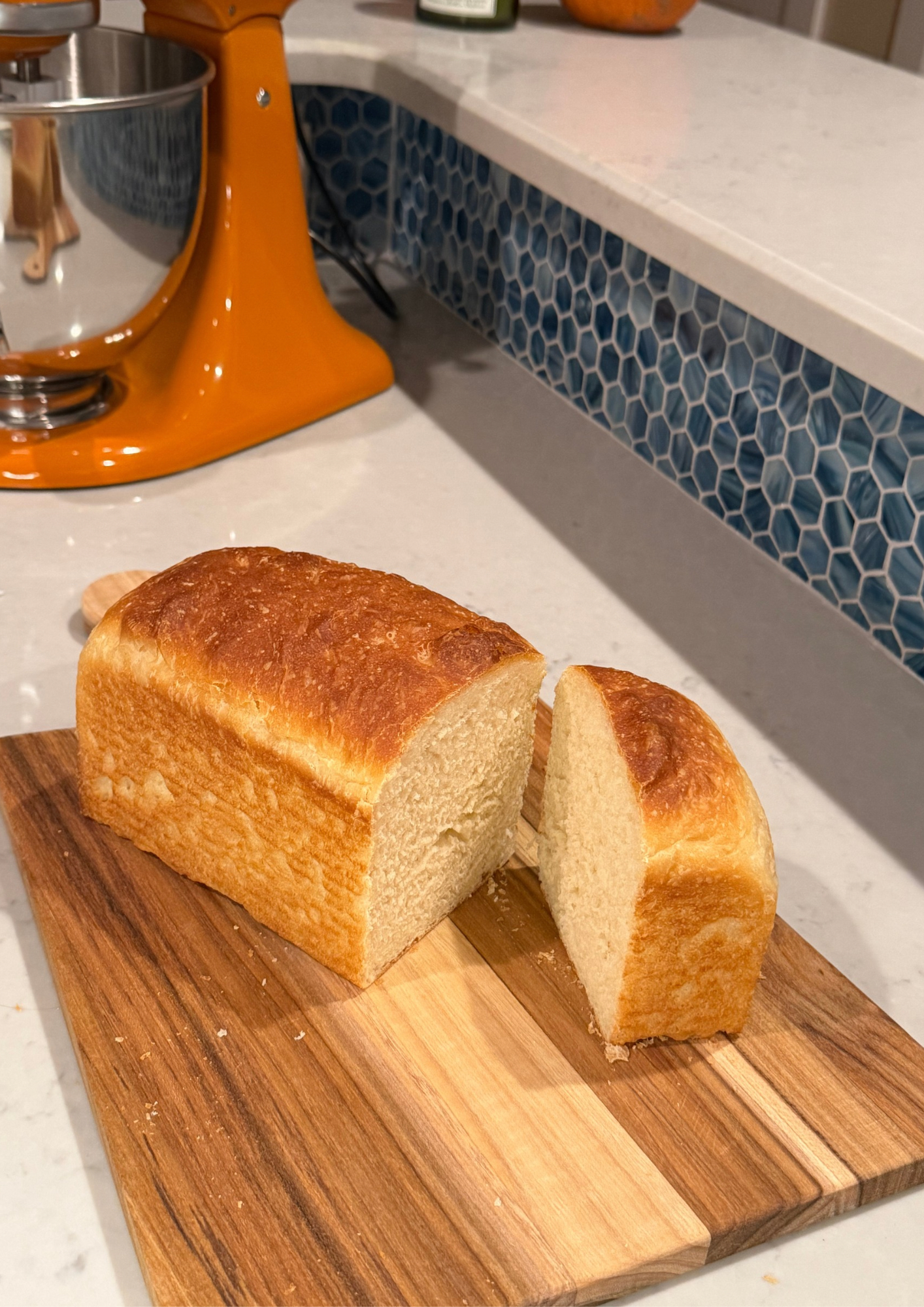
Japanese-Style Sandwich Bread
This easy Japanese-style sandwich bread is a mix between traditional Japanese milkbread (Shokupan) and a classic sandwich loaf. The end result is a pillowy soft and light bread that is very versatile: perfect for steak sandwiches, but also a homemade PB&J.
 Stand mixer (optional)
 Bread
Bread
Japanese-Style Sandwich Bread
This Japanese-style sandwich bread is super flavorful and fun to make. It’s made with a tangzhong: a cooked flour paste that keeps your bread extra moist, which results in a pillowy soft, light crumb.
Ingredients
- For the tangzhong
- For the dough
Method
In a small or medium saucepan, add the milk and flour. Cook on medium heat while stirring with a whisk, making sure there are no flour lumps left. Keep stirring until the mixture starts to thicken and it can hold its shape. It should have the consistency of a thick, smooth pudding and your whisk should leave visible lines in the mixture when you stir it. Once you reach this consistency, transfer the mixture to a small bowl and cover with cling film, pressing it against the paste so you prevent a skin from forming. Let cool until it reaches room temperature. If you want to know more about what exactly a tangzhong is and what it does in your bread, see the note below.
In the bowl of your stand mixer (if you don’t have a stand mixer, just use a regular large bowl), add the cooled tangzhong and all the other dough ingredients. Mix on low speed for 10-15 minutes (if not using a stand mixer, first stir with a wooden spoon, then mix by hand for about 15 minutes). The dough should now have a slightly tacky consistency. Transfer the dough to a lightly floured (no more than 1 tbsp flour!) work surface and form into a tight ball. Transfer into a lightly greased bowl and cover with a damp cloth or plastic wrap. Let rest until doubled in size, this should take about 1 to 1.5 hours depending on your kitchen temperature.
Tip the dough ball onto a lightly floured (again, no more than 1 tbsp) work surface. You’re now going to shape the loaf by gently pressing down the dough ball, then lightly stretching it into a rectangle which should have the same length as your loaf pan (I use a 9x5 in pan (20x10 cm)), and about three times the width. Starting at the long side the furthest away from you, roll the dough towards you while also pulling it away from you with your thumbs, to create tension. When the dough is fully rolled, let it rest on the seam side while you prepare the loaf pan. Oil the bottom and all sides of the pan and put a piece of parchment paper down (both short sides of the pan don’t need paper). Carefully place the loaf in the pan, seam side down, and loosely cover with plastic. Let rest again, for 1 hour, checking the loaf every now and then, adjusting the plastic if the rising dough is pressing against it. With about 20 minutes of rising time left, preheat your oven to 375°F (190°C).
If you want your loaf to have a shiny crust, beat one room-temperature egg and give the top a gentle egg wash right before baking. Bake the loaf for 30-40 minutes or until the internal temperature reads 188°F (87°C). Take the loaf out of the oven and leave in the pan on your counter for 5 minutes, then tip out onto a cooling rack. Let it cool completely before slicing (I know that requires some patience but it is worth it! The loaf will be much easier to slice).
Note: A tangzhong is a paste made by mixing flour and water or milk. It's a Chinese baking technique, related to the Japanese yudane method used in shokupan, that gained popularity in the West in the mid-2000s. By heating flour and liquid, the starches in the flour absorb liquid and swell - they gelatinize. These cooked starches now hold onto more moisture, which will cause your bread to be softer and stay moist for longer. The sweet spot for your tangzhong is to heat it up to 149-165°F (65-74°C). Don’t worry if you don’t have a thermometer, just keep an eye out for the right consistency, which should be thick and pudding-like. Slightly overheating your tangzhong isn’t going to ruin your bread, but letting it boil for several minutes will make it less effective.